
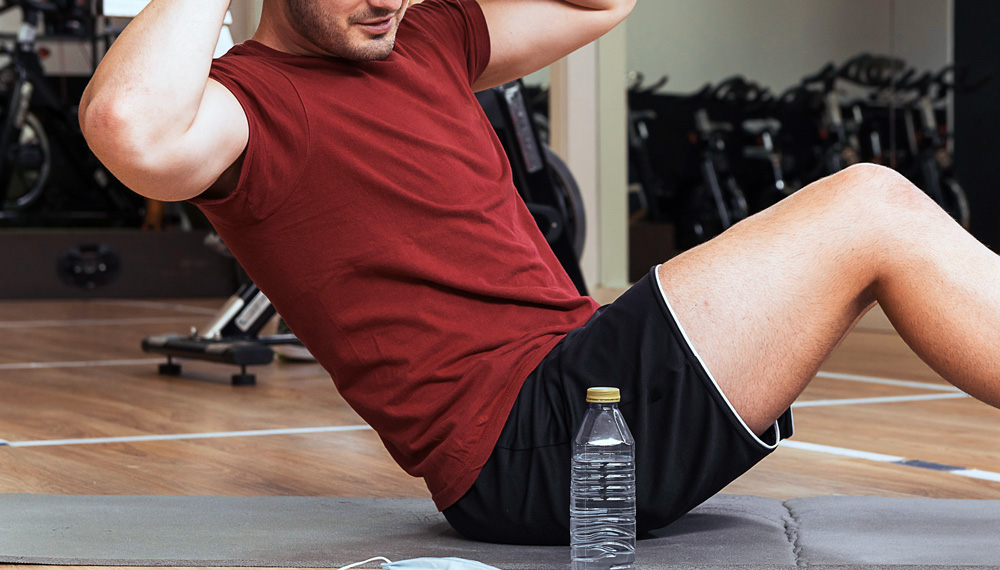
You’ve heard it a thousand times: “If your back hurts, you just need a stronger core.” So, you head to the gym, hammer out three sets of 50 crunches, and spend ten minutes doing back extensions
But instead of feeling like a functional athlete, you wake up the next morning feeling like a rusty hinge.
It’s a frustrating irony. You’re doing exactly what the “online experts” told you to do, yet your lower back is screaming louder than ever. The truth is that most “core” workouts are actually masterclasses in spinal destruction if not controlled correctly. Here is why your quest for a six-pack might be the very thing sabotaging your spine.
The Hip Flexor Hijack
When your deep core muscles—like the transverse abdominis—are weak or “sleepy,” your body finds a workaround to complete the task. Usually, that means your hip flexors (the psoas) take over. Obviously, every person has the ability to compensate differently but with modern day sedentary lifestyles, hip flexors are a common culprit.
The psoas is a powerful muscle that attaches directly to your lumbar vertebrae which is why we can all use it as a substitute for our core when needed. When it works too hard during leg raises or sit-ups, it literally yanks on your spine and causes a slight twist while trying to do the core’s job. You think you’re training your abs, but you’re actually just giving your spine a high-tension tug-of-war and potentially aggravating the issue you are trying to correct.
Training for Movement, Not Stability
The biggest misconception in fitness is that the core’s job is to move the spine. In reality, the core’s primary job is to stop the spine from moving.
Your core is a stabilizer. It’s meant to be a rigid pressure cylinder that protects your spinal column while your hips and shoulders do the heavy lifting with their large and powerful muscles. When you focus on “crunching” and “twisting,” you’re training for instability. To protect your back, you need to train anti-movements:
- Anti-Extension: (e.g., Planks)
- Anti-Rotation: (e.g., Pallof Press)
- Anti-Lateral Flexion: (e.g., Suitcase Carries)
How to Fix It
If you want to save your back, stop trying to “feel the burn” through movement and start focusing on stability.
- Ditch the Crunches: Swap them for Bird-Dogs or Dead Bugs. These challenge your core to keep your spine perfectly still while your limbs move.
- Learn to Brace: Instead of “sucking your belly button to your spine” or holding your breath, imagine someone is about to punch you in the stomach. That 360-degree tension is true core stability.
- Breathe into Your Belly: If you’re chest-breathing during a plank, your core isn’t actually engaged.
Your back doesn’t need more movement; it needs a better support system. Stop treating your spine like a hinge and start treating it like the stable foundation it is. At the Institute for Sports Physiotherapy and Performance,we train all our patients the importance of quality over quantity, stability over power and precision over speed.