
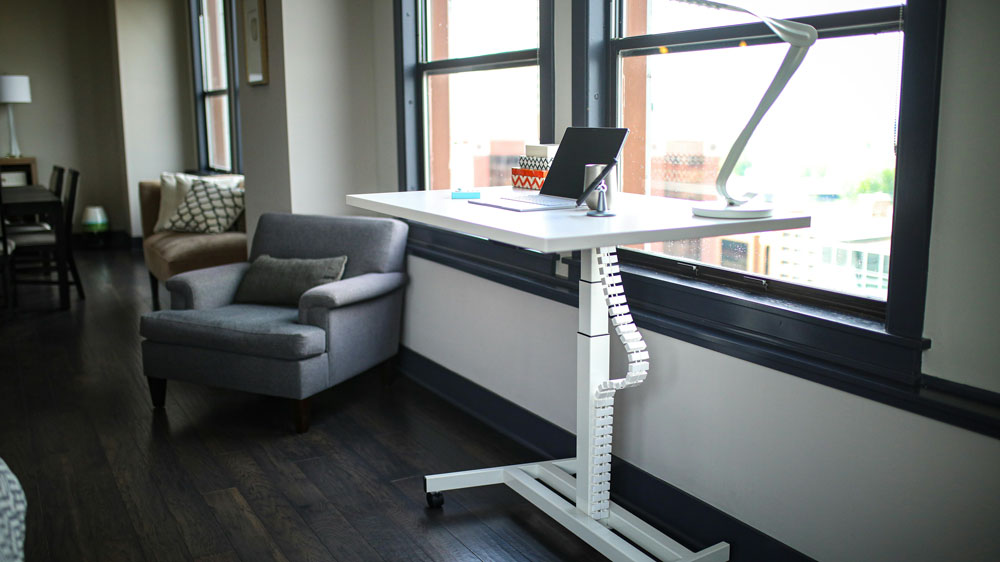
The standing desk was supposed to be the “holy grail” of office health. We were told that “sitting is the new smoking” and that by simply rising to our feet, our back pain would vanish, our calories would burn, and our productivity would soar.
But for many, the reality is a different kind of misery: a nagging ache in the outer hip, a pinching sensation in the groin, or a stiff lower back by 3:00 PM. The truth is, standing is still a “load” on your body. If you swap a bad sitting posture for a bad standing one, you aren’t solving the problem—you’re just changing the coordinates of the pain.
Here are the five most common mistakes people make with standing desks that are secretly wrecking their hips.
1. The “Kickstand” (Hanging on One Hip)
We’ve all done it. You get tired, so you shift all your weight onto one leg and let your hip “pop” out to the side. This is the ultimate “passive” posture.
When you hang on your hip, you aren’t using your muscles for stability; you’re hanging on your ligaments and joint capsule. This creates massive compression on the lateral hip (gluteal tendons), leading to bursitis or tendinopathy.
- The Fix: Keep your weight distributed 50/50. If you need a break, take a walk; don’t turn into a human kickstand.
2. The “Donald Duck” (Anterior Pelvic Tilt)
When our core gets tired, our pelvis tends to tilt forward, our belly pushes out, and our lower back arches excessively. This puts your hip flexors in a constant state of “shortened” tension and pinches the front of the hip joint.
- The Fix: Think precision over posture. Engage your glutes slightly and “tuck” your tailbone just enough to feel your core kick in.
3. Locking Your Knees
Locking your knees feels “easier” because it requires zero muscle activity. However, it shunts all the weight of your upper body directly into your hip and knee joints. It also restricts blood flow, which is why people often feel “heavy legs” after standing for an hour.
- The Fix: Maintain “soft” knees. A micro-bend ensures your muscles—not your cartilage—are doing the work. Even better, do some calf raises, rocking forward and back or small marching on the spot.
4. Standing Too Long (Quantity Over Quality)
This is where the “Quantity over Quality” trap kills your progress. Standing for four hours straight is just as bad as sitting for four hours straight. Static load is the enemy of joint health. Your body need movement to lubricate the joints with synovial fluid.
- The Fix: Follow the 20:8:2 rule. Sit for 20 minutes, stand for 8, and move/stretch for 2.
5. The “Concrete Trap” (Hard Floors & Bad Shoes)
Standing on a hardwood floor or thin carpet in flat shoes (or barefoot) offers zero shock absorption. Your hips are the first major “dampeners” for the force of your body weight hitting that hard surface.
- The Fix: Invest in a high-quality running shoes. It provides the right amount of cushioning, arch support and instability to keep the legs working properly for longer. We prefer them over the anti-fatigue mats so you do not have to rearrange the office every time you want to change position.
Movement Over Posture
Your body wasn’t designed to be a statue. Whether you are sitting or standing, the best “posture” is your next posture. Optimizing human function is what we do at the Institute for Sports Physiotherapy and Performance. This includes coaching patients through work set ups and giving tips and tricks to manage the necessary evil that is work. Book an assessment today to get started at correcting that work station posture.