
We’ve all been there: that one stubborn “knot” in your shoulder or calf that feels like a marble buried under your skin. You’ve massaged it, rolled on a foam roller until you saw stars, and stretched until you were blue in the face—yet the tension remains.
If your muscles feel like they’ve been tied in a permanent double-knot, it might be time to stop guessing and start targeting with Dry Needling. It’s not just another “feel-good” therapy; it’s a precision strike designed to hit the bullseye of your pain.
What Exactly is Dry Needling? (No, It’s Not Voodoo)
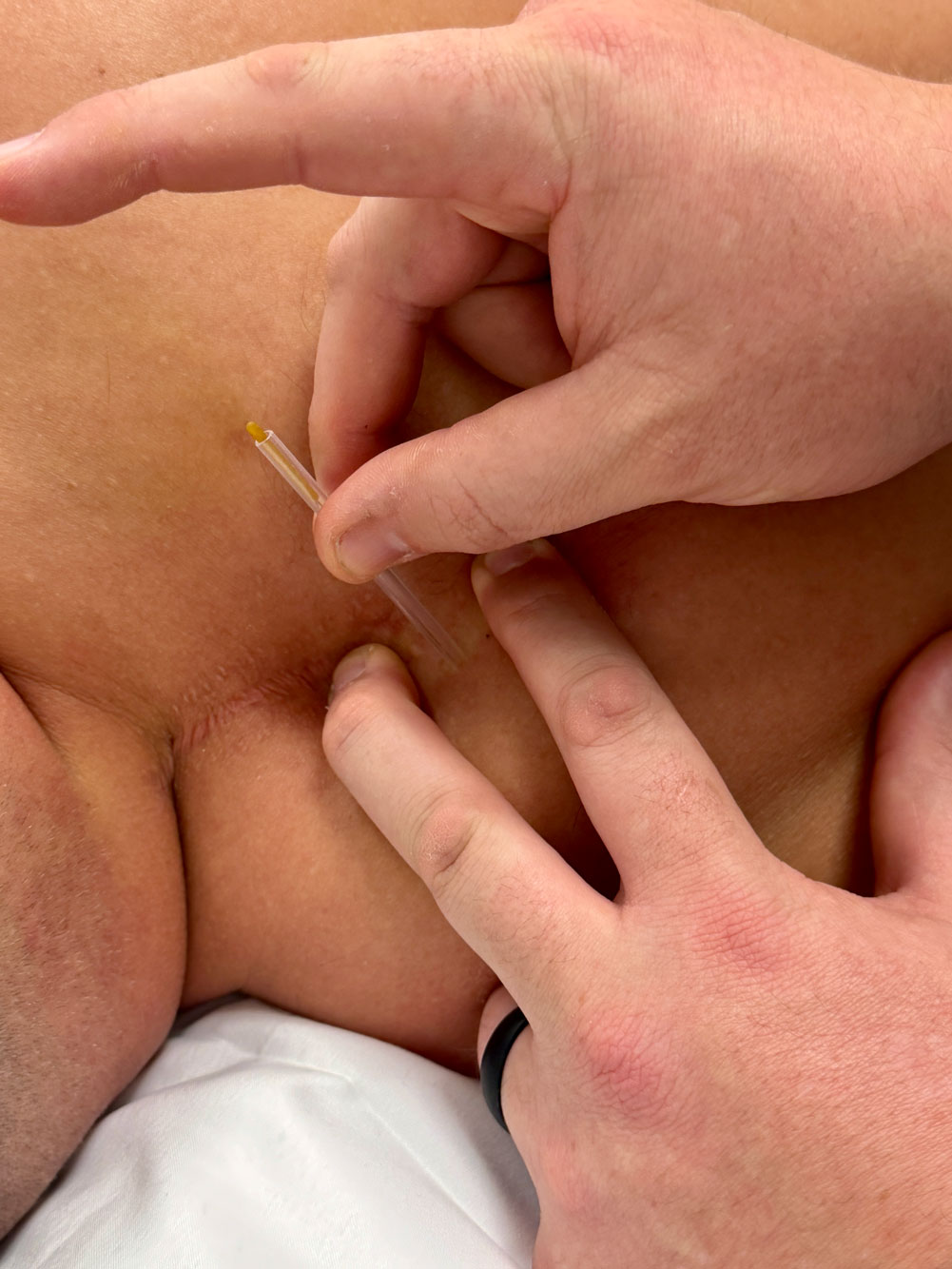
Dry needling involves inserting a fine, stainless steel filiform needle directly into a myofascial trigger point—essentially a hyper-irritable spot in a taut band of muscle.
The term “dry” simply means there is no medication or injection involved. The needle itself is the treatment. While it uses the same type of needles as acupuncture, the philosophy is rooted in Western medicine and human anatomy rather than traditional energy meridians. It’s about anatomy, not “Qi.”
The “Twitch Response”: The Muscle Saying “Uncle”
When the needle hits a trigger point, it often elicits a Local Twitch Response (LTR). This is a brief, involuntary contraction of the muscle fibers. It can feel a bit weird—like a tiny muscle cramp or a dull ache—but it is the “holy grail” of the treatment.
Why the twitch matters: This response is the physical sign that the muscle is “rebooting.” It interrupts the pain signaling loop between the muscle and the brain, essentially forcing the muscle to let go of its chronic contraction. We do get the same benefit in the muscle that doesn’t “twitch”, but the instant effects are greater when we hit the bullseye.
This process does three critical things:
- Chemical Reset: It flushes out accumulated metabolic waste (like lactic acid) that keeps the muscle irritated.
- Neurological Reset: It calms the nervous system’s overreaction to the injury. It also fatigues the local nerve ending causing a weakness or tired feeling after.
- Blood Flow Boost: It encourages fresh, oxygenated blood to rush into the area, kickstarting the healing process because your brain assumes that you have “damaged the muscle”
Dry Needling vs. Acupuncture: What’s the Difference?
It’s the most common question in the clinic. While the tools are identical, the “map” is entirely different.
| Feature | Dry Needling | Accupuncture |
| Foundation | Western Anatomy & Physiology | Traditional Chinese Medicine (TCM) |
| Goal | Release trigger points & muscle tension | Balance energy flow (Qi) & organ health |
| Placement | Directly into the “knot” or affected tissue | Along specific meridians (energy channels) |
| Primary Use | Musculoskeletal pain & sports injuries | Holistic wellness, stress, & internal health |
Why Pair It With Physiotherapy?
Dry needling is rarely a standalone cure—it’s the “door opener.” By using dry needling to “deactivate” a painful trigger point, your physiotherapist creates a window of opportunity. With the muscle finally relaxed, you can perform corrective exercises and stretches with a greater range of motion and significantly less pain.
It turns a “stiff” rehab session into a high-performance one, allowing you to build strength in a muscle that was previously too “locked up” to work.
The Bottom Line
Dry needling isn’t about “poking” for the sake of it; it’s about precision. It’s a fast, evidence-based way to tell a chronically tight muscle to relax. At the end of the day, the specific and target exercises completed by you at home is what does the real work in regaining mobility and improving sports performance. Give us a call at 519-258-4777 to book an appointment with one of our clinicians rostered to do dry needling.